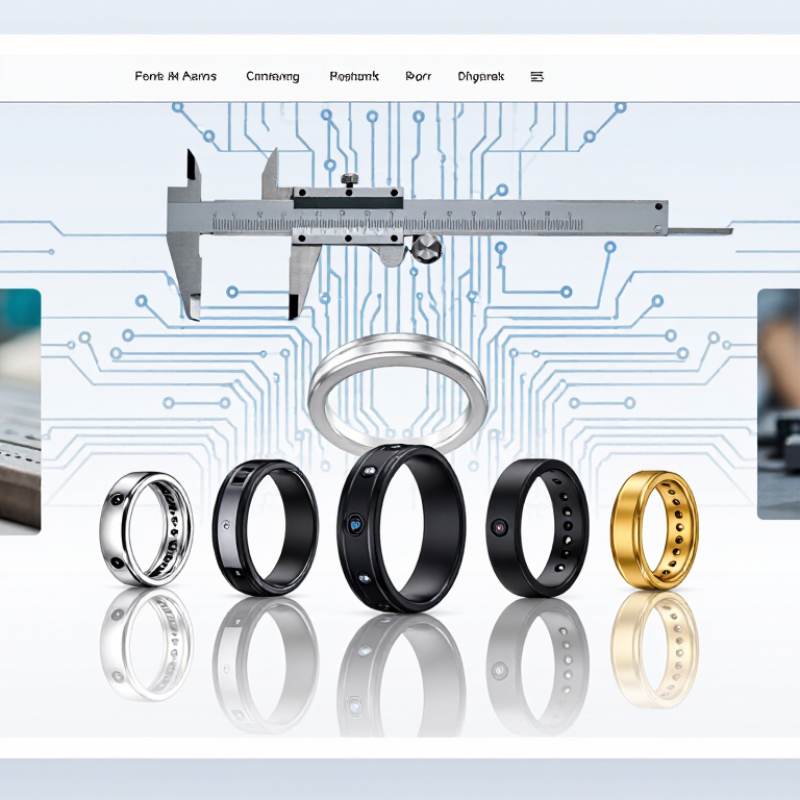
China Top Wearable Technology Ring Manufacturers
China’s wearable-device ecosystem brings together component suppliers, product designers, and contract manufacturers. For buyers exploring China Top Wearable Technology Ring Manufacturers, a polished product photo is only a starting point. The details matter: sensor placement, skin comfort, battery life, app stability, and how clearly a supplier explains testing. Small differences show up during daily wear.
A useful industry perspective comes from Tom Hale, CEO of Oura, whose public commentary has stressed unobtrusive health tracking. A fair paraphrase of that idea is: “The best health technology fits naturally into everyday life.” That principle is useful when assessing any Wearable Technology Ring. A ring should feel comfortable during sleep, provide readable data, and avoid making ordinary routines harder. Simple to say. Harder to deliver.
This guide examines manufacturers through practical criteria, including engineering capability, customization, quality-control processes, and communication. It also considers the limits of product claims. Sensor readings can vary with fit, movement, and individual differences; no specification sheet tells the whole story. Ask for clear documentation, sample units, and realistic delivery details before choosing a partner. China offers many manufacturing options, but the right supplier depends on the intended market, product requirements, and support needs. Some comparisons may remain imperfect, because public information is not always consistent. That deserves attention, not guesswork.
Overview of China's Wearable Technology Ring Industry
China’s wearable technology ring industry is developing within a mature electronics supply chain. Manufacturers can draw on local expertise in miniature sensors, battery integration, precision machining, and compact assembly. These capabilities matter: a ring has little room for its optical sensors, charging contacts, and battery. Yet strong manufacturing capacity does not guarantee accurate readings or comfortable all-day wear.
IDC’s Worldwide Quarterly Wearable Device Tracker reported 538.9 million global wearable-device shipments in 2024, up 6.1% year over year. This figure covers wearables broadly, not smart rings alone, so it should not be read as ring-market size. Public, comparable data specifically for Chinese ring shipments remains limited. Buyers and product teams should therefore examine measured sensor performance, battery life under typical use, sizing options, and quality-control procedures—not just production claims. The picture is still uneven.
Tips: Ask for repeatability results across different skin tones and movement conditions. Test whether the ring stays comfortable during sleep, handwashing, and daily tasks. A polished prototype is not enough. Request clear methods and sample details before trusting performance figures.
Key Technologies Behind Wearable Smart Rings
China Top Wearable Technology Ring Manufacturers
Key Technologies Behind Wearable Smart Rings
A smart ring packs sensors, a battery, and wireless components into a narrow band worn against the skin. Optical sensors use light to detect changes in blood flow, supporting estimates of pulse and related trends. Tiny motion sensors track movement during sleep and daily activity. Small components. That is the challenge.
Reliable readings depend on more than sensor choice. Skin tone, ring fit, hand movement, and temperature can affect signal quality. Software filters noisy measurements and looks for patterns across time, rather than treating every reading as exact. These figures can support personal wellness tracking, but they are not a substitute for clinical assessment. A loose ring may simply record less useful data.
Battery design and heat control matter in such a compact device. Low-power chips help extend use between charges, while careful circuit layout limits wasted energy. Manufacturers also need consistent sealing around sensors and charging contacts to resist moisture from ordinary wear. A comfortable inner surface helps keep sensors in place, though one size will not fit every finger equally well. Calibration remains an imperfect detail, and users should interpret trends with that limitation in mind.
China Top Wearable Technology Ring Manufacturers — Key Technologies Behind Wearable Smart Rings
Indicative Battery Life of Consumer Smart Rings
Many consumer smart rings specify roughly 4–7 days of use per charge. Low-power sensors, efficient Bluetooth Low Energy, and power-management strategies help extend runtime in a compact device. Actual battery life varies with features, usage, and battery condition; the range is indicative, not a market-wide measurement.
Leading Wearable Ring Manufacturers in China
China’s leading wearable ring manufacturers combine compact electronics, precision molding, and production experience in small-form devices. Their teams may support sensor integration, tooling, firmware adaptation, and assembly under one roof. This can shorten communication loops, though it does not guarantee a reliable finished product.
A practical supplier review should look beyond a polished sample. Ask how the factory checks optical sensor alignment, battery capacity, charging contacts, and Bluetooth stability. Request test records for repeated charging, sweat exposure, and daily movement. Small differences matter. A ring that fits neatly on a desk may feel bulky after several hours of wear.
Manufacturing depth varies, even among suppliers with similar catalogs. Some handle design and production; others depend on outside partners for key components. That detail is easy to miss. Before committing, compare sample performance with stated specifications, confirm who owns tooling, and agree on inspection criteria in writing. No checklist removes every risk. Measurements can also look good while comfort remains disappointing, so trial units should be worn by people with different hand sizes. A careful buyer treats each claim as a question to verify, not a promise to accept.
Manufacturing Capabilities and Quality Standards
For China’s wearable ring manufacturers, capability is visible in small details: a smooth inner edge, consistent wall thickness, and sensors that sit steadily against the finger. Production may combine precision machining, polishing, coating, assembly, and calibration. Each step needs measurable tolerances, not just visual inspection. IDC reported 534.6 million wearable-device shipments worldwide in 2024, up 6.1% from 2023. This figure covers the broader wearable category, not smart rings alone, but it signals growing pressure for reliable, repeatable production. Small products leave little room for error.
Quality systems should connect incoming-material checks with in-process inspections and final testing. ISO 9001 can support documented process control, while accredited laboratories can test selected performance or safety characteristics. For rings, useful checks include dimensional consistency, coating wear, sweat exposure, charging cycles, sensor repeatability, and water-ingress resistance against a stated test level. Ask manufacturers for test methods, sample sizes, and failure records—not only certificates. A certificate is not proof that every batch performs equally. No test is perfect. Sensor readings can also vary with fit, skin contact, and movement, so calibration claims need clear limits. That gap deserves attention. A capable supplier should explain both its controls and what they cannot guarantee.
How to Evaluate Chinese Smart Ring Manufacturers
Evaluating Chinese smart ring manufacturers requires more than comparing prices and polished samples. IDC reported that worldwide wearable-device shipments reached 538.9 million units in 2024, up 6.1 percent year over year. That broader market growth makes production readiness worth checking carefully. Ask for monthly capacity, recent delivery records, and documented defect rates. Request a pilot batch, not only a hand-finished sample. Inspect ring sizing, charging contacts, and sensor placement under ordinary lighting. Small flaws matter.
Technical evidence matters too. Bluetooth SIG’s 2024 market update projected annual Bluetooth device shipments would rise to 7.5 billion by 2028. For a ring, confirm the manufacturer can provide connectivity test results, battery-cycle records, and sensor calibration procedures. Ask how it tests readings across different skin tones, temperatures, and movement levels. A neat dashboard is not proof of reliable data. Review the app’s update process and data-handling documentation, and clarify who controls each production change. Get answers in writing.
Factory visits can reveal whether inspection steps happen on the line or only before shipment. Check whether staff can trace a ring from component lot to final test. Ask how rejected units are recorded and corrected. Some suppliers may lack long-term field data; that is worth admitting, not glossing over. Compare evidence, not promises. A lower quote can conceal weaker testing or inconsistent materials.
China Top Wearable Technology Ring Manufacturers - How to Evaluate Chinese Smart Ring Manufacturers
Use this checklist to compare potential suppliers. Numerical targets below are buyer-defined screening criteria, not universal industry specifications or claims about any particular manufacturer.
| Evaluation Dimension | What to Verify | Practical Screening Criteria | Evidence to Request | Why It Matters |
|---|---|---|---|---|
| Product and engineering capability | Experience with ring-sized electronics, optical sensors, motion sensors, antennas, charging systems, and firmware. | Confirm that the supplier can demonstrate a working sample and explain the design, test process, and known limitations of each key feature. | Technical specification, sample unit, product architecture overview, and a documented development schedule. | Small enclosures leave limited space for batteries, sensors, and antennas; design trade-offs can affect comfort, connectivity, and runtime. |
| Health-data claims | How heart-rate, sleep, activity, or temperature-related readings are measured, processed, and presented. | Require test methods and clearly defined measurement conditions. Do not treat wellness features as medical claims unless the relevant regulatory requirements have been met. | Measurement protocol, validation report, supported-use statement, and documentation of any limitations. | Sensor readings can vary with fit, skin contact, movement, temperature, and individual physiology. Clear claims help manage compliance and customer expectations. |
| Battery and charging | Battery capacity, charging method, charging time, cycle testing, and runtime under stated operating conditions. | Set a runtime requirement for your intended feature settings, then test samples using the same settings. Ask for test conditions rather than relying on a headline figure. | Battery specification, runtime test report, charging instructions, and applicable battery transport documentation, such as UN 38.3 test-summary information where relevant. | Always-on sensing, Bluetooth use, firmware, and battery aging can all affect real-world runtime. |
| Materials and skin contact | Ring material, coating, surface finish, skin-contact components, and material-control procedures. | Specify the required material and finish in the purchase documents; request testing or declarations appropriate to the destination market and product use. | Bill of materials, material declarations, relevant laboratory reports, and incoming-material inspection records. | Material selection affects durability, comfort, corrosion resistance, and the suitability of the product for prolonged skin contact. |
| Water resistance | Tested ingress-protection rating, test conditions, sealing design, and limitations after wear or damage. | Ask for the exact rating and the associated test report. Confirm the conditions covered; do not assume that a rating guarantees suitability for every water activity. | Laboratory test report, product marking details, care instructions, and production leak-test procedure. | Water-resistance performance depends on the tested design and conditions. Wear, impact, repairs, and aging may affect sealing. |
| Wireless connectivity | Bluetooth functionality, pairing process, supported operating systems, data synchronization, and radio compliance. | Test pairing and synchronization with the phone models and operating-system versions relevant to your customers; verify applicable Bluetooth qualification and market-specific radio requirements. | Compatibility matrix, connection test results, Bluetooth qualification details where applicable, and radio test reports for target markets. | Connectivity issues can lead to failed onboarding, missing data, and a high return or support rate. |
| Mobile app and data handling | App ownership and maintenance, supported languages, data storage, account deletion, privacy controls, and software update process. | Confirm who controls the app and backend, how long support is planned, and how users can access or delete data under applicable privacy requirements. | App demonstration, software support plan, privacy documentation, update policy, and data-flow description. | A wearable’s customer experience depends on its app and data services as well as its hardware. |
| Quality management | Documented production controls, traceability, inspection stages, nonconformance handling, and corrective actions. | Verify that quality records can be linked to production lots. An ISO 9001 certificate can be useful evidence, but it does not replace product-specific quality checks. | Quality-system certificate and scope, inspection plan, sample inspection records, traceability example, and corrective-action procedure. | Repeatable controls help reduce variation between samples and mass-production units. |
| Pilot and production testing | Functional checks, sensor checks, charging checks, cosmetic inspection, and final inspection before shipment. | Agree acceptance criteria before ordering. For example, buyers may set a pilot-lot defect limit of less than 1%; define the defect classification and sampling method in writing. | Test specifications, pilot-lot results, inspection report, and a mutually agreed acceptance-sampling plan. | Written criteria make quality disputes more objective and help identify production issues before larger orders. |
| Compliance and market access | Applicable safety, electromagnetic compatibility, radio, chemical, labeling, and environmental requirements for each sales destination. | Build a market-specific compliance checklist. Requirements vary by jurisdiction; CE, FCC, RoHS, and REACH references should be checked for applicability and scope rather than treated as interchangeable approvals. | Current test reports and declarations, certificate or registration details where required, product-label artwork, and confirmation that documents match the supplied model. | Incorrect or incomplete compliance documentation can delay market entry or create regulatory and customs risks. |
| Sizing and fit | Available inner diameters, measurement method, sizing kit, fit guidance, and tolerance control. | Confirm the sizing system and inner-diameter tolerances before sampling. Test the sizing kit and finished ring against your target customer group. | Dimensioned drawings, tolerance specifications, sizing-kit samples, and inspection records. | Fit affects comfort, sensor contact, and the likelihood of returns or inaccurate readings. |
| Customization and intellectual property | Custom tooling, firmware or app changes, ownership of deliverables, and protection of confidential information. | Define ownership, permitted use, confidentiality, and tooling access in the contract before development begins. | Written development scope, tooling terms, confidentiality agreement, and software or design ownership clauses. | Clear terms reduce disputes over custom designs, source materials, and future supplier changes. |
| Commercial and supply-chain readiness | Minimum order quantity, lead time, component sourcing, production capacity, warranty process, and spare-unit policy. | Request separate timelines for sample development, pilot production, and repeat orders; confirm how component shortages and schedule changes are communicated. | Quotation, production schedule, capacity plan, warranty terms, and documented escalation contacts. | Transparent planning helps buyers manage launch dates, inventory, after-sales obligations, and supply risks. |