

Top JS Twin Shaft Concrete Mixer Manufacturers Worldwide
Choosing a reliable Js Twin Shaft Concrete Mixer manufacturer requires more than comparing catalog prices. Worldwide suppliers differ in mixing performance, steel quality, automation, and after-sales support. A trusted manufacturer should demonstrate practical experience with ready-mix plants, precast production, and demanding construction sites. Their equipment must handle moisture changes, variable aggregate sizes, and repeated daily cycles without unstable discharge.
This guide examines leading manufacturers through clear, practical criteria. We consider shaft design, paddle arrangement, mixing uniformity, liner durability, motor protection, and maintenance access. Details matter. A well-designed mixer should open its inspection doors easily and remove hardened concrete without excessive downtime. Verified production records, factory testing, technical documentation, and responsive service also strengthen a supplier’s credibility. Certification helps, but it should support real performance rather than replace it.
Field experience can reveal weaknesses that brochures hide. Some manufacturers publish impressive cycle times, yet actual results may change with local materials and operator habits. That deserves attention. Buyers should request test reports, reference projects, spare-parts information, and realistic delivery schedules before making decisions. This article compares worldwide manufacturers with a balanced approach, recognizing that no single supplier fits every plant. The strongest choice combines dependable engineering, transparent communication, and long-term operating value. Performance should be proven, not simply promised.
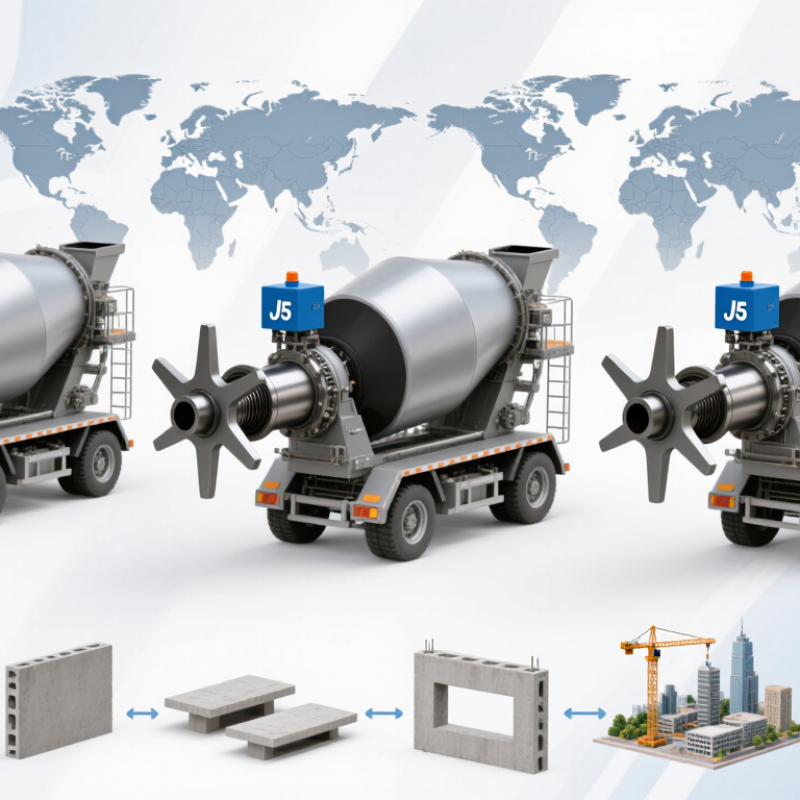
JS Twin-Shaft Mixers: 1–6 m³ Batches and 30–60-Second Mixing Cycles
In commercial concrete production, JS twin-shaft mixers are valued for strong shear action and steady material movement. Models handling 1–6 m³ batches suit precast plants, infrastructure projects, and ready-mix yards. Smaller batches support flexible scheduling. Larger batches improve output when demand remains stable.
A practical mixing cycle often lasts 30–60 seconds after all materials enter the chamber. That timing depends on cement type, aggregate grading, moisture, and admixture dosage. Dry aggregates may need longer conditioning. Wet materials can shorten the useful cycle, but they may also increase sticking.
Operators should check slump, visual uniformity, and discharge consistency instead of trusting the timer alone.
The clock is only a guide.
When comparing manufacturers worldwide, buyers should examine shaft sealing, wear-resistant liners, paddle geometry, and gearbox protection. These details affect reliability during repeated daily cycles. Ask for batch records, test data, and service response times.
A good supplier should explain capacity honestly, including usable volume rather than listing only chamber size. Maintenance access matters too. Grease points, inspection doors, and replaceable wear parts should be reachable without awkward dismantling.
In real plants, small delays become expensive. Even a well-designed mixer can underperform when aggregate moisture changes sharply or operators overload the batch. Regular calibration and operator training remain necessary.
Global Manufacturer Comparison by 25–120 m³/h Output Capacity
Top JS Twin Shaft Concrete Mixer Manufacturers Worldwide
Global comparison by output capacity should begin with the 25–120 m³/h range. Smaller 25–40 m³/h mixers suit urban projects, precast yards, and restricted sites. Units producing 50–80 m³/h fit highway sections and commercial foundations. The 100–120 m³/h class supports continuous, high-volume placement. However, rated output is not actual production. Moisture variation, aggregate size, loading time, and discharge delays can reduce performance.
Twin shaft mixers usually deliver strong shear and consistent blending through synchronized shafts. During equipment evaluations, buyers should inspect mixing time, shaft sealing, wear protection, and cleaning access. A reliable machine should maintain quality across repeated batches, not only during a factory test.
Energy use also matters. A high-output model can become inefficient when the daily workload remains low. That point is often overlooked.
Tips: Compare tested output, not brochure capacity. Request batch records for your target mix. Check whether the mixer reaches its rated volume with local aggregates. Inspect replacement-part access and service response before purchasing. Ask about dust control and operator safety features. Small details matter. Capacity alone can mislead.
Key Specifications: 18.5–110 kW Drive Systems and Wear Protection
Top JS Twin Shaft Concrete Mixer Manufacturers Worldwide
Key Specifications: 18.5–110 kW Drive Systems and Wear Protection
Twin shaft concrete mixers commonly use drive systems from 18.5 to 110 kW. The correct rating depends on batch volume, aggregate size, moisture, and mixing resistance. An 18.5 kW system may suit smaller batches and stable materials. Larger industrial mixers often require 75–110 kW for dense concrete and continuous production. More power is not automatically better. Oversizing can increase energy use, heat, and maintenance costs.
The International Energy Agency reports that cement production creates about 2.5 gigatonnes of direct CO2 emissions yearly. It also accounts for roughly 7% of global energy-related emissions. Efficient mixing therefore matters beyond output speed. Variable-speed drives can reduce unnecessary load during startup and discharge. However, real savings depend on controls, operator settings, and material consistency. Specifications alone cannot prove efficiency.
Wear protection deserves equal attention. Replaceable liners, reinforced mixing arms, and abrasion-resistant steel help protect the trough and shafts. Aggregate containing quartz can cause severe abrasion, especially around discharge gates and blade edges. Practical inspections should measure liner thickness, shaft seal leakage, and unusual vibration. A 2023 industrial maintenance report from the U.S. Department of Energy emphasizes condition monitoring as a way to reduce unplanned downtime. That principle applies here, although field conditions are rarely perfect. Even good calculations can fail when operators overload the mixer or delay liner replacement.
Quality Benchmarks Under EN 206, ASTM C94, and ISO 9001
Global twin-shaft concrete mixer manufacturers should be judged against practical quality controls, not brochure claims. EN 206 focuses on concrete performance, production, and conformity. A capable manufacturer therefore designs mixers for consistent blending and repeatable discharge. Operators should inspect paddle wear, shaft alignment, and residual material after each batch. Uneven color or dry pockets can reveal poor mixing, even when the machine looks powerful.
ASTM C94 emphasizes requirements for ready-mixed concrete, including uniformity, delivery, and testing procedures. Mixer suppliers should support these needs with stable cycle times, accurate dosing, and accessible sampling points. Ask for batch records, calibration evidence, and service histories. ISO 9001 adds a controlled quality management system, but it does not prove concrete performance by itself. That distinction matters. Factory audits should examine incoming steel, weld inspections, motor testing, and corrective-action records. Small details matter. In field use, even a reliable mixer may lose consistency when overloaded or poorly maintained. Manufacturers should state those limits clearly. Some published capacity figures feel optimistic, and buyers should challenge them with site trials, test batches, and independent verification. Consistent results are earned through process discipline, not equipment size alone.
Top JS Twin Shaft Concrete Mixer Manufacturers Worldwide — Quality Benchmarks Under EN 206, ASTM C94, and ISO 9001
This chart presents a standards-based comparison framework rather than company or brand performance data. It highlights the principal reference areas used when evaluating concrete production consistency, fresh-concrete acceptance, and quality-management systems.
Interpretation: EN 206 organizes durability exposure into six main families: X0, XC, XD, XS, XF, and XA. ASTM C94 commonly addresses slump, air content, concrete temperature, and strength acceptance. ISO 9001:2015 defines auditable requirements primarily within Clauses 4 through 10. These figures are standards-based reference counts and are not manufacturer ratings.
Worldwide Supplier Selection by Application, Service, and Spare Parts Availability
Selecting a JS twin shaft concrete mixer supplier starts with the application, not the brochure. Ready-mix plants need stable output during repeated daily cycles. Precast production may require accurate moisture control and fast batch changes. Roller-compacted concrete demands strong mixing action against stiff, abrasive materials. Ask suppliers for test data using aggregates similar to yours. A laboratory result with different materials can mislead.
Service quality often decides whether a mixer remains productive after installation. Look for commissioning support, operator training, troubleshooting guides, and clear maintenance schedules. Remote diagnosis is useful, but local technical coverage matters more during a gearbox or seal problem. Confirm response times in writing. Also check whether the supplier can provide drawings, wiring details, and multilingual instructions. Small details matter.
Spare parts availability deserves a practical review. Request stock information for paddles, liners, seals, bearings, shafts, and gearbox components. Ask about normal lead times and emergency delivery options. Parts should include specifications, revision numbers, and installation guidance. Compatibility is not always obvious. A cheaper part may cause uneven wear or unexpected downtime. I have seen polished supplier presentations hide weak after-sales planning. No supplier is perfect. Buyers should inspect reference plants, verify service records, and compare five-year operating risks instead of choosing only by purchase price. A written spare-parts forecast can reveal whether the supplier understands your production reality.
Top JS Twin Shaft Concrete Mixer Manufacturers Worldwide - Worldwide Supplier Selection by Application, Service, and Spare Parts Availability
Anonymous supplier-selection matrix based on common international JS twin-shaft mixer configurations, application requirements, after-sales support practices, and spare-parts accessibility.
| Supplier Category | Best-Fit Application | Typical Nominal Mixing Capacity | Typical Theoretical Output | Common Drive Configuration | Typical Installation Scale | Service Coverage | Spare-Parts Availability | Typical Export Lead Time | Customization Capability | Selection Assessment |
|---|---|---|---|---|---|---|---|---|---|---|
| Large export-oriented Asian manufacturers | Commercial ready-mix plants, precast yards, road projects, bridges, dams, and general infrastructure | 1.5–6.0 m³ per batch | 45–180 m³/h, depending on cycle time and plant layout | Two electric motors, commonly 2 × 18.5–55 kW; hydraulic discharge gates are also available | Compact mobile installations through high-volume stationary plants | Remote commissioning, installation manuals, online troubleshooting, and optional field technicians | High availability for standard wear parts; custom shafts and gearboxes normally require longer planning | 30–90 days, depending on configuration, electrical standard, and shipping schedule | High; liners, discharge gates, control panels, moisture sensors, and inlet arrangements can be specified | Strong value and broad configuration range |
| European industrial mixer manufacturers | High-duty precast production, dry-cast concrete, architectural concrete, and demanding automated plants | 1.0–6.0 m³ per batch | 40–150 m³/h, with emphasis on controlled mixing quality | High-efficiency dual-drive systems, often with variable-frequency control and monitored torque | Fully automated stationary plants and specialized production lines | Structured commissioning, preventive-maintenance programs, technical documentation, and regional service networks | Very high for standard components; original wear parts may carry a premium price | 60–150 days for engineered systems; shorter for standard units held in regional inventory | Very high; process controls, mixing tools, liners, discharge geometry, and automation can be engineered | Best for process control and long-term plant integration |
| Regional manufacturers serving the Middle East and Africa | Hot-climate concrete production, infrastructure projects, block plants, and remote construction sites | 1.5–4.5 m³ per batch | 45–135 m³/h | Dual electric motors with reinforced gear transmission and heavy-duty discharge components | Stationary plants, containerized layouts, and semi-mobile project installations | Pre-shipment testing, commissioning support, remote diagnostics, and distributor-based field service | Good for liners, blades, seals, bearings, and discharge-gate components; local stock varies by country | 45–120 days, plus inland transport and customs clearance | High; dust protection, climate adaptations, reinforced wear packages, and local voltage options are common | Strong fit for harsh environments and remote projects |
| South Asian manufacturers | Road construction, housing programs, precast blocks, small-to-medium ready-mix plants, and public works | 1.0–3.0 m³ per batch | 30–90 m³/h | Dual motors commonly ranging from 2 × 15–37 kW, subject to aggregate size and moisture conditions | Small and medium stationary plants with relatively simple control systems | Dealer support, operator training, basic commissioning, and telephone or video assistance | Good domestic availability for standard wear parts; imported electrical and gearbox components may need advance ordering | 30–90 days for standard models | Moderate to high; hopper dimensions, liners, motors, and discharge arrangements can usually be adjusted | Practical choice for cost-sensitive regional projects |
| North American engineered-system suppliers | Large ready-mix facilities, municipal infrastructure, high-throughput precast, and automated batching systems | 3.0–9.0 m³ per batch | 90–270 m³/h, depending on batch cycle and plant automation | Heavy-duty dual-drive systems with industrial motors, torque monitoring, and integrated safety controls | Large stationary plants and centralized automated production facilities | Regional field service, planned maintenance, operator training, safety documentation, and integration support | High within regional distribution networks; engineered components may be supplied on a scheduled basis | 60–180 days for custom plant packages; standard replacement parts are usually faster | Very high; automation, washout systems, dust control, load cells, and plant software integration are common | Best for large-scale automation and local service response |
| Specialized precast and dry-cast system builders | Pipe, paving stone, hollow block, segment, facade, and low-slump concrete production | 0.5–3.0 m³ per batch | 20–100 m³/h, depending on product cycle and required compaction consistency | High-torque dual drives with optimized mixing tools for low-slump and zero-slump materials | Dedicated production lines with automated material handling | Process trials, recipe development, commissioning, and production-optimization support | High for application-specific mixing tools and liners; non-standard components may be made to order | 60–150 days for customized equipment | Very high; mixing arms, paddles, liners, moisture control, and discharge timing can be tailored | Best for product-specific mixing performance |
| Mobile and project-focused equipment suppliers | Temporary infrastructure works, airport projects, mines, remote construction, and short-term batching operations | 1.0–3.0 m³ per batch | 30–90 m³/h | Compact dual-drive arrangement with simplified plant controls and transport-friendly dimensions | Skid-mounted, trailer-mounted, or rapidly relocatable plants | Fast setup assistance, operator instruction, remote support, and project-based field service | Moderate to high for standard wear parts; remote-site stocking is recommended | 30–75 days for standard mobile configurations | Moderate; transport dimensions, hopper design, generator compatibility, and discharge height are commonly adjusted | Best for mobility, quick deployment, and temporary sites |
| Low-maintenance and lifecycle-focused suppliers | Continuous commercial production where uptime, predictable maintenance, and operating cost are priorities | 2.0–6.0 m³ per batch | 60–180 m³/h | Energy-efficient dual drives with accessible inspection points, centralized lubrication, and replaceable wear liners | Medium and large stationary plants operating multiple shifts | Preventive-maintenance schedules, inspection checklists, wear monitoring, and annual service contracts | Very high for critical wear components; recommended parts packages can be supplied for 12–24 months of operation | 45–120 days for equipment; planned spare-parts packages are usually shipped separately | High; liner materials, lubrication systems, access platforms, sensors, and maintenance arrangements can be specified | Best for uptime and total cost of ownership |
Selection note: Capacity, output, motor power, lead time, and service levels are typical industry ranges rather than audited claims for a specific company. Final selection should verify aggregate size, concrete slump, moisture variation, batch cycle, applicable electrical standards, warranty terms, local service coverage, and the availability of critical spare parts such as mixing arms, paddles, liners, seals, bearings, gearboxes, and discharge-gate components.

