

Who Are the Top Custom Kitchenware Manufacturers?
Choosing a custom kitchenware manufacturer is not just a search for the lowest quote. The right partner should match your product, production volume, and quality expectations. A stainless-steel saucepan, for example, needs consistent wall thickness, secure handle joints, and a smooth rim. A ceramic mug calls for an even glaze and careful checks for chips. Details matter.
This guide explores manufacturers by looking at practical signals: material options, sample quality, production capacity, customization services, and communication. Ask for clear specifications and inspect pre-production samples before approving a large order. Request relevant quality records, too. Good evidence beats broad promises. A polished website alone proves little.
There is no universal winner. A small brand may value flexible order quantities, while an established retailer may need repeatable output across large batches. Compare quotes alongside tooling fees, packaging options, stated lead times, and how the supplier handles defects or changes. Ask specific questions. Listen closely. Some details may still be unclear, and that deserves a follow-up rather than an assumption. Rankings can simplify a complex choice; they cannot replace your own product checks. Use the manufacturer profiles ahead as a starting point, then verify whether each company fits your needs.
What Defines a Custom Kitchenware Manufacturer?
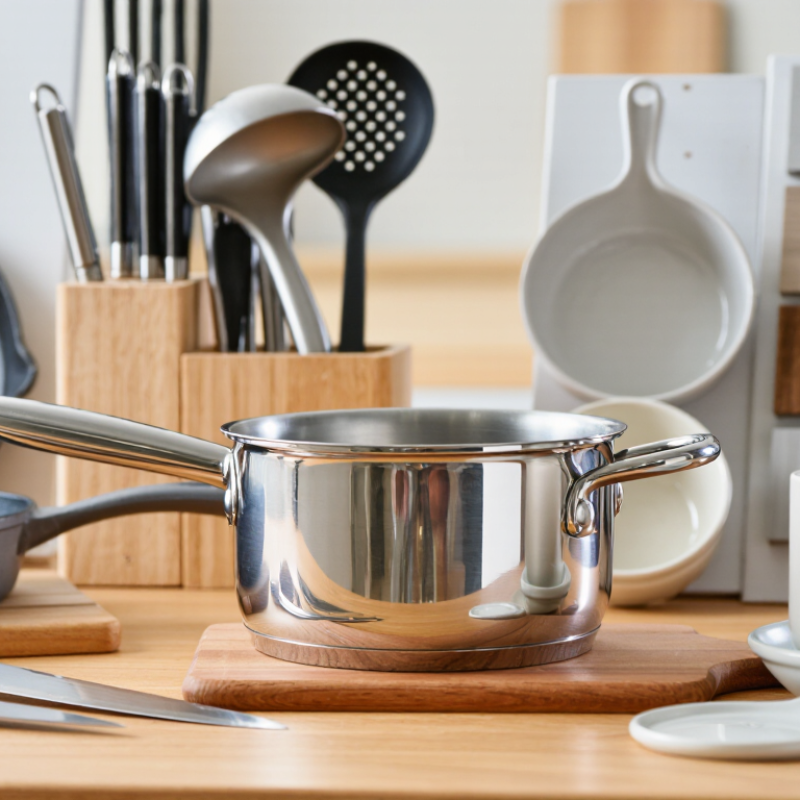
A custom kitchenware manufacturer turns a specific use case into a repeatable product. It can adapt dimensions, materials, finishes, grip shapes, and packaging—not merely print a logo on standard stock. The work starts with clear drawings, sample approval, and agreed tolerances. A handle that feels secure with dry hands may slip when wet. Small details matter.
Manufacturing capability means controlling those details at scale. Ask how the supplier tests heat resistance, edge smoothness, coating adhesion, and dimensional consistency. Request a production sample, not just a polished prototype. Grand View Research valued the global kitchenware market at USD 77.4 billion in 2023 and projected 4.6% annual growth through 2030. That expanding market makes reliable repeat production as important as flexible design.
Customization should also fit real user needs. McKinsey’s 2021 personalization report found that 71% of consumers expect personalized interactions; 76% feel frustrated when they do not receive them. This broad consumer finding is not kitchenware-specific, but it signals rising expectations. Still, more options are not always better. A bespoke utensil can look elegant on paper and feel awkward during a long shift. Strong manufacturers validate designs with practical trials, document material specifications, and explain where customization adds cost or production complexity.
How Are Leading Manufacturers Evaluated?
A serious evaluation starts with evidence from the factory, not a polished sample. Review material specifications, supplier traceability, production capacity, and inspection records. For stainless-steel items, ask how grades are verified and how surface defects are checked under consistent lighting. The International Stainless Steel Forum reported 58.4 million tonnes of global stainless-steel production in 2023. That scale offers context, but it does not prove that a particular supplier can maintain quality. Market demand matters too: Grand View Research estimated the global cookware market at USD 27.57 billion in 2023 and projected a 6.6% compound annual growth rate through 2030. These figures support checking whether a manufacturer can scale without weakening controls.
Product testing should reflect real use. Ask for results covering handle strength, coating adhesion, corrosion resistance, and repeated washing, where relevant to the product. Confirm that test methods, sample sizes, and pass criteria are documented. Samples can mislead. A polished sample may hide uneven production between batches, so compare units from more than one run. For custom orders, assess drawing accuracy, prototype revisions, tooling ownership, and communication when specifications change. Audits and certificates are useful, but neither replaces production records or independent test reports. Strong manufacturers can explain failures plainly and show how corrective actions were verified. That evidence is more persuasive than a broad promise of “premium quality.”
Which Manufacturers Lead the Custom Kitchenware Market?
Which manufacturers lead the custom kitchenware market? The strongest partners are not always the largest. They combine dependable production, practical design support, and clear quality controls. Look for teams that can explain material choices, mold limits, food-contact testing, and how they inspect finished goods. A capable manufacturer should also share realistic lead times and sample costs before production begins. Details matter: a handle that feels comfortable with wet hands, or a lid that seals after repeated washing, can distinguish a useful product from a disappointing one. Small tests reveal a lot.
Tips: Request a physical sample and test it as customers would. Check edges, balance, coating consistency, and packaging. Ask how defects are recorded and corrected, not just whether inspections happen.
Market leaders also tend to offer flexible order volumes and communicate promptly when specifications change. Their expertise may cover stainless steel, silicone, wood, or ceramic, but no supplier excels at every material or process. Compare written specifications, sample results, and after-sales support rather than relying on polished catalogs. A low quote can hide tooling fees or narrow quality tolerances. Still, even careful comparisons cannot remove every uncertainty; production can vary, and buyers should leave room for a second review.
Who Are the Top Custom Kitchenware Manufacturers? - Which Manufacturers Lead the Custom Kitchenware Market?
A single cross-category manufacturer ranking is not shown here: market leadership depends on product type, region, and buyer requirements. The comparison below highlights verifiable capabilities and standards to use when evaluating custom kitchenware suppliers, without naming companies or brands.
| Evaluation dimension | What a strong custom-kitchenware supplier offers | Evidence or benchmark to check |
|---|---|---|
| Product development | Design support, prototypes, material selection, and a documented process for approving custom specifications. | Review drawings, sample approval records, tolerances, and the final product specification. |
| Material suitability | Materials selected for the intended use, such as stainless steel for durable cookware or food-contact plastics for suitable utensils and storage products. | Request material grades, supplier declarations, and test documentation that matches the product’s intended use and market. |
| Food-contact compliance | A process for identifying applicable food-contact rules and substantiating compliance for the finished product. | For the EU, check applicable requirements under Regulation (EC) No 1935/2004 and food-contact good manufacturing practice rules. For the US, confirm the applicable FDA food-contact requirements for the material and conditions of use. |
| Manufacturing processes | Processes suited to the product design, which may include metal forming, machining, molding, glass forming, or assembly. | Check process capability, production samples, tooling ownership terms, and inspection plans for the specific product. |
| Quality management | Documented incoming-material, in-process, and final-product checks, with a procedure for handling defects and corrective actions. | If ISO 9001 certification is claimed, verify its scope and validity. ISO 9001 is a quality-management-system standard, not a product-safety certification. |
| Customization and finishing | Options such as dimensions, handles, surface finishes, colors, packaging, and product markings, subject to material and regulatory limits. | Approve a production-equivalent sample and confirm durability, cleaning, labeling, and packaging requirements before ordering. |
| Supply reliability | Clear production schedules, capacity planning, order-change controls, and traceability for materials and finished goods. | Ask for written lead times, production capacity for the requested item, batch records, and a plan for delays or quality issues. |
| Supplier selection | A supplier whose materials, process expertise, compliance documentation, and production scale match the specific kitchenware category. | Compare quotations against the same specification, testing scope, order quantity, packaging, and delivery terms. |
What Products and Customization Services Do They Offer?
Custom kitchenware manufacturers typically produce cookware, bakeware, knives, utensils, cutting boards, storage containers, and serving pieces. Depending on their equipment and minimum order quantities, they may offer private-label production, custom dimensions, material choices, finishes, colors, handle designs, and logo placement. A practical brief should specify the intended use: a shallow pan for fast service, a heavy-bottomed pot for steady heat, or stackable containers for a compact kitchen. Details matter. Ask for samples and confirm food-contact materials, care instructions, tolerances, and packaging before approving a large order.
The opportunity is substantial, but customization is not automatically better. Grand View Research estimated the global cookware market at USD 29.51 billion in 2022 and projected a 6.7% compound annual growth rate from 2023 to 2030. That figure describes the broader cookware market, not custom products alone. It does suggest why manufacturers offer more material and design options. Stainless steel, aluminum, cast iron, and coated surfaces each handle heat and cleaning differently. A custom handle may look elegant yet feel awkward after a full shift. Not always. Request a production sample, test it with the actual ingredients and washing routine, and check whether replacement parts will remain available. Good specifications matter more than decorative choices.
How Can Buyers Choose the Right Manufacturer?
Choosing a custom kitchenware manufacturer starts with a clear product brief. Specify materials, dimensions, finish, expected order volume, and packaging needs. A sketch with measurements can prevent avoidable misunderstandings.
Ask how the manufacturer controls quality at each production stage. Request material specifications, sample inspection records, and details about handling defects. For a metal utensil, check the edge, handle balance, and surface finish in person. For a container, test the lid repeatedly and inspect the seal. Samples are useful, but one sample cannot prove every production batch will match.
Check whether the supplier can meet your timeline and explain its capacity in practical terms. Ask for a production schedule, quality checkpoints, and references from comparable projects. Clear answers matter. If responses stay vague, pause before paying for a large order. A small trial order can reveal packing problems or inconsistent finishes, though it adds time and cost. Price still matters, but compare quotes against material thickness, inspection scope, and shipping terms. I would not treat a glossy sample as proof of reliable production; that assumption is easy to make and hard to correct later.
Choosing a Custom Kitchenware Manufacturer: Material Expertise
A manufacturer's ability to work with different metals can affect cookware performance and design options. Compare its material expertise with your product requirements, and also check tooling capabilities, quality controls, minimum order quantities, and lead times.
Representative thermal conductivity values at approximately room temperature; actual values vary by alloy and condition. Reference: Engineering ToolBox, “Thermal Conductivity of Metals.”

