
How to Choose the Best Mist Sprayers in 2026?
Choosing the best Mist Sprayers in 2026 starts with the job, not the product label. A fine mist may suit delicate seedlings, while a greenhouse bench or patio garden can need a wider, steadier pattern. Check the nozzle, tank capacity, trigger feel, and whether the spray remains even after repeated use. A useful test is simple: spray a leaf from the intended distance and look for consistent coverage, not large runoff drops.
Horticulturist Dr. Linda Chalker-Scott is known for an evidence-based approach to plant care. I can’t verify a direct quotation from her about mist sprayers, so I won’t invent one. The practical principle for this guide is: “Match the tool to the plant and the task.” That means considering droplet size, reach, and cleaning needs before comparing features. A clogged nozzle can turn a promising sprayer into a frustrating one.
This guide will compare manual, pump, and battery-powered options, with attention to comfort, durability, and value. It will also explain which specifications matter in real use and which may be mostly marketing. Small details count. A slippery grip matters when your hand is damp; a tank that is hard to rinse can retain residue. No single model suits every space, and product claims deserve a little skepticism. The right choice should make routine care easier, not merely look impressive on a shelf.
Understanding Mist Sprayers and Their Main Uses
A mist sprayer turns liquid into fine droplets, but its purpose varies by setting. In a garden, a hand or pump sprayer can wet leaves, apply suitable plant-care solutions, or support delicate seedlings. In greenhouses, fixed misting nozzles are often used to raise humidity and reduce heat around young plants. For household cleaning, a controlled spray can cover hard surfaces without pouring liquid over them. These jobs need different droplet sizes, pressure, and reach. One tool rarely does everything well.
Look beyond the word “mist.” Check whether the nozzle produces an even pattern, whether seals tolerate the intended liquid, and whether the tank feels comfortable when full. EPA’s WaterSense program reports that outdoor use accounts for about 30% of average U.S. household water use, much of it for landscape irrigation. That figure is not a promise that misting saves water; poor aim can waste it. Use short bursts, test on a small area, and avoid spraying in wind. A little trial and error helps. It can still be messy. In 2026, match the sprayer to the task, not to a broad “multi-use” claim.
How to Choose the Best Mist Sprayers in 2026? Understanding Mist Sprayers and Their Main Uses
Droplet size is one factor in choosing a sprayer. Fine droplets can provide light, even coverage; medium droplets suit many general spraying tasks; and coarse droplets are useful for more directed wetting. These ranges are approximate, and actual droplet size varies with the sprayer, nozzle, pressure, and liquid. Consider the target, desired coverage, and potential for drift when selecting a sprayer.
Matching Sprayer Types to Your Application
A good mist sprayer starts with the job, not the label. For houseplants or a small cleaning task, a hand-trigger sprayer offers control and quick refills. Choose an adjustable nozzle if you need to switch between a fine cloud and a firmer stream. Fine mist is useful for evenly dampening leaves, but it can drift onto nearby furniture or floors. Test the pattern over a sink or tray.
For larger areas, a pump-up sprayer can reduce repeated hand squeezing and hold more liquid. It suits broad, steady coverage, such as watering a group of pots. Check that its seals and tank materials are compatible with the liquid you plan to use. A sprayer designed for water may not tolerate every cleaning solution. Compatibility matters.
For delicate surfaces, seedlings, or personal-care liquids, favor a fine, consistent output and a comfortable trigger. Look for easy disassembly, since residue can clog a small nozzle. Rinse it after use and let the parts dry. A fancy spray pattern is not always an improvement. Sometimes the simplest sprayer works better, though I would still check its output on a small area before committing. Nozzle choice, droplet size, and reach all affect the result.
| Sprayer Type | Typical Capacity | How It Works | Best-Suited Applications | Advantages | Considerations |
|---|---|---|---|---|---|
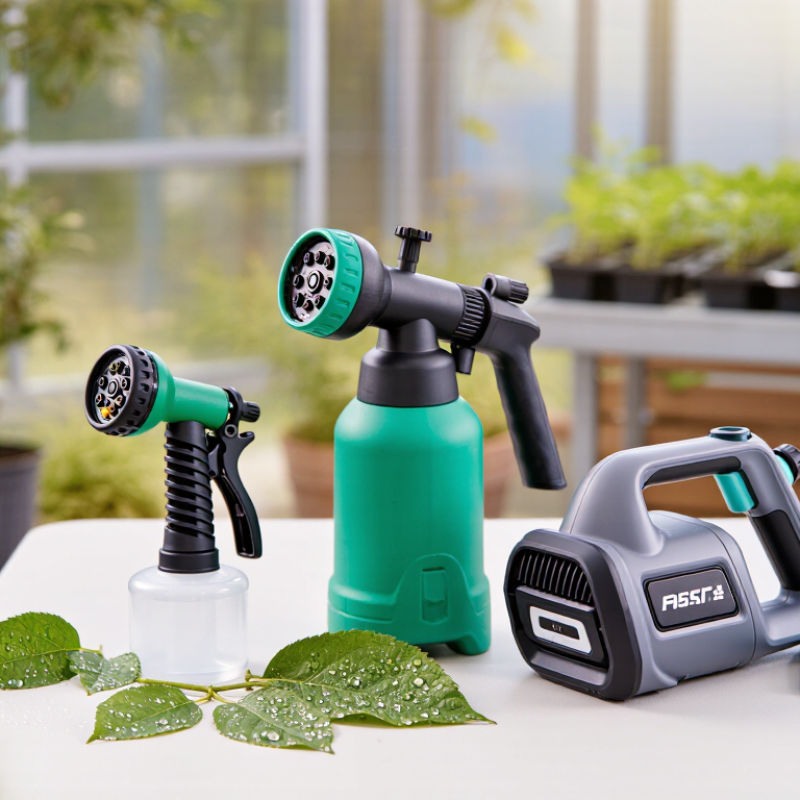
| Trigger sprayer | About 0.3–1 L | A hand-operated trigger draws liquid through a dip tube and releases it as a spray; many models offer adjustable spray patterns. | Spot misting, household plants, small cleaning tasks, and treating a few individual items. | Inexpensive, easy to refill, and convenient for short, targeted jobs. | Requires repeated hand operation; limited capacity and coverage make it unsuitable for large areas. |
| Hand-pump sprayer | About 1–2 L | A manual pump pressurizes the container; a valve and nozzle release the liquid. Pressure must be restored as it falls during use. | Houseplants, seedlings, small patios, and occasional spot treatments. | Portable and simple, with more working capacity than a trigger bottle. | Output can weaken as pressure drops; repeated pumping may be tiring during longer jobs. |
| Compression sprayer | About 3–8 L | A hand pump pressurizes a sealed tank, providing a continuous spray while the trigger is held. | Garden beds, shrubs, small lawns, and other routine outdoor treatments. | Useful balance of capacity and portability; typically allows a longer spray interval than a small hand sprayer. | Requires manual pumping and carrying a pressurized tank; check seals, pressure limits, and nozzle compatibility. |
| Battery-powered handheld sprayer | About 1–5 L | An electric pump supplies liquid to the nozzle, reducing or eliminating manual pumping during application. | Repeated plant care, indoor or greenhouse work, and small-to-medium treatment areas. | More consistent effort than manual pumping and convenient for frequent use. | Needs charging and cleaning; runtime and flow rate vary by model, battery, nozzle, and liquid. |
| Battery-powered backpack sprayer | About 10–20 L | A battery-driven pump feeds a hand wand or boom; the operator carries the tank on the back. | Larger gardens, orchards, landscaping, and extended coverage where a wheeled unit is impractical. | Higher carrying capacity and less manual pumping than a hand-compression backpack unit. | Full tanks add substantial weight; consider fit, balance, battery runtime, and access to replacement parts. |
| Cold fogger (ULV) | Varies by unit; commonly a small portable reservoir | An electric motor atomizes liquid into fine droplets without heating it. Droplet size and output depend on the device and settings. | Applications specifically labeled for fogging, such as certain controlled indoor or enclosed-space treatments. | Can produce a fine airborne mist for products and procedures intended for fog application. | Not a general-purpose garden sprayer. Use only products and application methods approved for the device and site; manage drift and inhalation exposure. |
| Powered mist blower | Tank capacity varies; backpack models often hold roughly 10–20 L | A powered fan carries droplets through an air stream; some units also pump liquid to the nozzle. | Large outdoor areas and vegetation where air-assisted delivery is appropriate and permitted. | Can project droplets farther than a basic hand sprayer and cover extensive outdoor areas. | Wind can carry droplets off target. Noise, fuel or battery needs, operator protection, and local use restrictions matter. |
Selection note: Capacity and performance ranges are typical examples, not specifications for every model. Choose a sprayer based on the product label, required application method, area size, target surface, and nozzle needs. Confirm that all wetted materials are compatible with the liquid, and follow label directions and applicable safety requirements.
Comparing Capacity, Nozzle Design, and Spray Performance
How to Choose the Best Mist Sprayers in 2026?
Comparing Capacity, Nozzle Design, and Spray Performance
Capacity affects how often you refill, but a larger tank is not automatically better. A compact sprayer feels lighter during detailed work, while a larger one suits longer sessions. Check the filled weight, not just the empty bottle. A heavy sprayer can tire your hand sooner than expected. Not always obvious. Also inspect the tank opening: a narrow neck may make filling and cleaning awkward. Clear markings help you track liquid use, though they can fade or become hard to read over time.
Nozzle design shapes the mist more than appearance suggests. Adjustable tips can shift from a fine cloud to a stronger stream, but they may need occasional cleaning. A fixed nozzle is simpler, yet its pattern may not suit every task. Look for an even spray without large droplets or sudden spurts. Test it on a sink or scrap surface, if possible, and check whether the trigger feels smooth through repeated pulls. Spray performance can change as the tank empties, so assess both a full and partly used sprayer. One detail is easy to miss: a very fine mist may drift away in moving air. Choose a pattern that fits your setting, not just the one that looks most impressive.
Checking Materials, Ease of Use, and Maintenance Needs
A good mist sprayer should feel sturdy without becoming tiring during repeated use. Check the bottle material, trigger, nozzle, and internal seals, since each part faces moisture and regular handling. A translucent bottle makes fill levels easy to see, while a wide opening helps prevent spills when refilling. Look for a nozzle that adjusts smoothly from a fine mist to a focused stream. Small details matter.
Ease of use becomes clear after several sprays, not just one. Test whether the trigger returns comfortably and whether the sprayer works at different angles. A long tube can help reach the last few drops, though it may not drain every shape of bottle equally well. I would not assume that a heavier model is automatically more durable; extra weight can make prolonged use less comfortable.
Maintenance needs vary with what you spray. Removable nozzles are easier to rinse, and simple parts are less frustrating when residue builds up. After use, empty the bottle if its contents may clog the nozzle, then flush the sprayer with clean water when appropriate. Check care instructions for material limits, especially with warm water or cleaning solutions. A sprayer that is easy to take apart may be tempting, but loose seals can cause leaks if reassembled poorly. That trade-off is easy to overlook.
Evaluating Safety, Warranty, and Overall Value in 2026
In 2026, judge a mist sprayer by more than its spray pattern. Check whether the filled reservoir sits steadily and the trigger returns smoothly after repeated presses. Look for guidance on materials, liquid compatibility, and pressure limits. The nozzle should adjust without excessive force. Test it with plain water over a sink before using it for its intended task. Small details matter.
Safety also depends on the instructions. Stay below the fill line, use only compatible liquids, and keep the nozzle pointed away from faces. If the bottle leaks around its neck or feels unusually pressurized, stop and inspect it rather than tightening parts blindly. Leaks are costly. Read the warranty terms carefully. Check coverage duration, exclusions for seals or nozzles, and whether proof of purchase is required. A long warranty can still offer little protection.
Compare the price with repairability, replacement parts, and ease of cleaning, not just advertised output. A comfortable grip may matter more than an extra spray setting during daily use. I might be giving durability too much weight; lighter models can be perfectly adequate for occasional jobs. Still, a sprayer that clogs after a week is poor value, even at a low price. Choose one whose safety guidance and support match your actual workload.

