How to Choose the Best LED Phototherapy Mask
Choosing the best Led Phototherapy Mask starts with a clear goal, not a glowing product photo. Different devices use different wavelengths, treatment schedules, and designs. Check the manufacturer’s specifications, safety information, and instructions before comparing prices. A mask should fit comfortably across the face, sit securely around the nose, and feel manageable during the recommended session. Small details matter.
Dermatologist and photomedicine specialist Dr. Michael H. Gold has published work on light-based skin treatments. A practical paraphrase of the evidence-focused approach is: “Look for clear specifications and realistic claims, not promises of instant results.” This is a paraphrase, not a verified verbatim quotation. It captures an important point: device quality cannot be judged by brightness alone. Check whether the product identifies its wavelengths, explains its intended use, and provides eye-safety guidance. If those details are missing, pause.
This guide will help you compare masks by wavelength information, comfort, usability, and evidence. It will also explain why consistent use matters more than a dramatic first impression. Some results may be subtle. Individual responses vary, and a home device is not a substitute for professional medical advice. If you have a skin condition, take photosensitizing medication, or are unsure whether light treatment is suitable, ask a qualified clinician before use. That extra step may feel inconvenient. It is worth considering.
Define Your Skin Goal: Acne Masks Commonly Use blue 405–420 nm Light
When acne is your main concern, look for a mask that clearly specifies blue-light wavelengths around 405–420 nm. This range is commonly used in acne-focused devices because blue light may affect acne-associated bacteria near the skin’s surface. It is not a cure, and results can differ with acne type, skin sensitivity, and consistent use.
Check the details. A trustworthy product description should state its wavelength range, recommended session length, and eye-protection guidance. A color label alone is not enough; two masks that look equally blue may deliver different light output. Fit matters, too. If the mask sits unevenly or feels uncomfortable, you may struggle to use it as directed. Follow the device instructions, and stop if you notice persistent irritation or discomfort.
Blue light may be more useful for some mild inflammatory breakouts than for deep cysts, blackheads, or acne driven by other factors. It can also leave dryness or sensitivity in some users, so avoid assuming that longer sessions work better. Results vary. If acne is painful, worsening, or leaving scars, ask a dermatologist about suitable care. I would also question dramatic before-and-after claims: lighting, camera angles, and other treatments can make comparisons misleading.
Compare Treatment Wavelengths: Red 630–660 nm and NIR 810–850 nm
Red light in the 630–660 nm range is commonly chosen for surface-focused skincare goals, such as supporting a more even-looking complexion. These wavelengths interact mainly with relatively superficial skin layers, though effects depend on the device and treatment conditions. A mask that lists only “red light” gives limited information; check its stated wavelength, coverage, and session time. Numbers matter.
Near-infrared light around 810–850 nm penetrates farther into tissue than red light. It is often paired with red wavelengths, but deeper penetration does not automatically mean better visible skin results. Evidence varies by device, dose, and study design, so wavelength alone cannot tell you how well a mask may work. I find this distinction easy to oversimplify. It is not simply “stronger is better.”
Compare the exact wavelength range and check whether irradiance is reported at the skin, not just the LED count. Follow the recommended schedule, protect your eyes as directed, and stop if you notice irritation or unusual heat. Keep expectations measured. Photos taken under the same lighting can help track gradual changes, though they cannot show what caused them. If you have a photosensitive condition or take light-sensitive medication, ask a qualified clinician before use.
Evaluate Dose Data: Check Irradiance (mW/cm²) and Fluence (J/cm²)
When comparing LED phototherapy masks, look beyond the number of lights. Irradiance describes the optical power reaching each square centimeter of skin, measured in milliwatts per square centimeter (mW/cm²). Fluence is the total energy delivered over a session, measured in joules per square centimeter (J/cm²). In simple terms, fluence depends on irradiance and exposure time. A mask delivering 10 mW/cm² for 10 minutes provides about 6 J/cm², assuming steady output.
Check how the figures were measured. Was the sensor placed at the skin, or farther from the LEDs? Does the specification describe average output or a peak reading? Small differences in distance and fit can change the light reaching your face. Look for wavelength and measurement details alongside the dose data. Numbers without context are hard to compare.
More power is not automatically better. The right dose depends on the device’s design and intended use, and longer sessions do not necessarily improve results. Follow the manufacturer’s timing guidance, and avoid extending sessions just to reach a higher fluence. Honestly, product specifications can be confusing; if the testing method is unclear, treat the stated dose as an estimate rather than a precise guarantee.
How to Choose the Best LED Phototherapy Mask — Evaluate Dose Data: Check Irradiance (mW/cm²) and Fluence (J/cm²)
Use irradiance measured at the treatment plane and calculate fluence from the actual exposure time. The values below are illustrative calculations only, not measurements of commercial products or recommended treatment doses.
| Dose-check example | Irradiance at treatment plane (mW/cm²) | Exposure time (seconds) | Calculated fluence (J/cm²) | What to check |
| Example A | 10 | 300 | 3 | Confirm the reading is taken where the skin would be, not only at the LED surface. |
| Example B | 20 | 300 | 6 | Check that the stated irradiance is supported by a measurement method and test conditions. |
| Example C | 30 | 300 | 9 | Ask whether the value is an average across the treatment area or a peak reading. |
| Example D | 40 | 300 | 12 | Look for readings at multiple points to assess how evenly light reaches the face. |
| Same fluence, different exposure | 20 | 600 | 12 | This matches Example D’s calculated fluence, but does not establish that the two exposure conditions have the same biological effect. |
Calculation: Fluence (J/cm²) = irradiance (mW/cm²) × exposure time (seconds) ÷ 1,000.
Selection checks: Compare measurements taken at the same distance and setup; verify the wavelength and measurement instrument; check irradiance across the treatment area; and distinguish measured values from estimates or peak outputs. Fluence alone does not establish safety or effectiveness, and appropriate use depends on the device instructions and individual circumstances.
Check Safety and Claims: Look for IEC 62471 and FDA 510(k) Details
When comparing LED masks, treat safety paperwork as evidence, not decoration. IEC 62471-1 evaluates photobiological hazards from optical radiation across 200–3,000 nm, including risks to eyes and skin. Ask for the actual test report, risk group, measured wavelengths, and testing distance. A label alone is thin evidence. Check that the report covers the exact mask configuration, not a similar lamp. The IEC standard assesses hazards; it does not prove claims about acne, wrinkles, or pain.
FDA 510(k) status also needs careful reading. The FDA describes clearance as a finding of substantial equivalence to a legally marketed device, not proof that every advertised benefit works. Read the public 510(k) summary for intended use, contraindications, and performance testing. For light dose, request irradiance in mW/cm² and treatment duration. For example, 20 mW/cm² for 10 minutes equals 12 J/cm², assuming constant output at the skin. This calculation is a check, not a treatment recommendation. I would be cautious if a seller provides a clearance number but omits the tested wavelength or exposure distance. Even a detailed report can leave practical questions unanswered.
Assess Fit and Use: Compare Coverage, Session Time, and Treatment Schedule
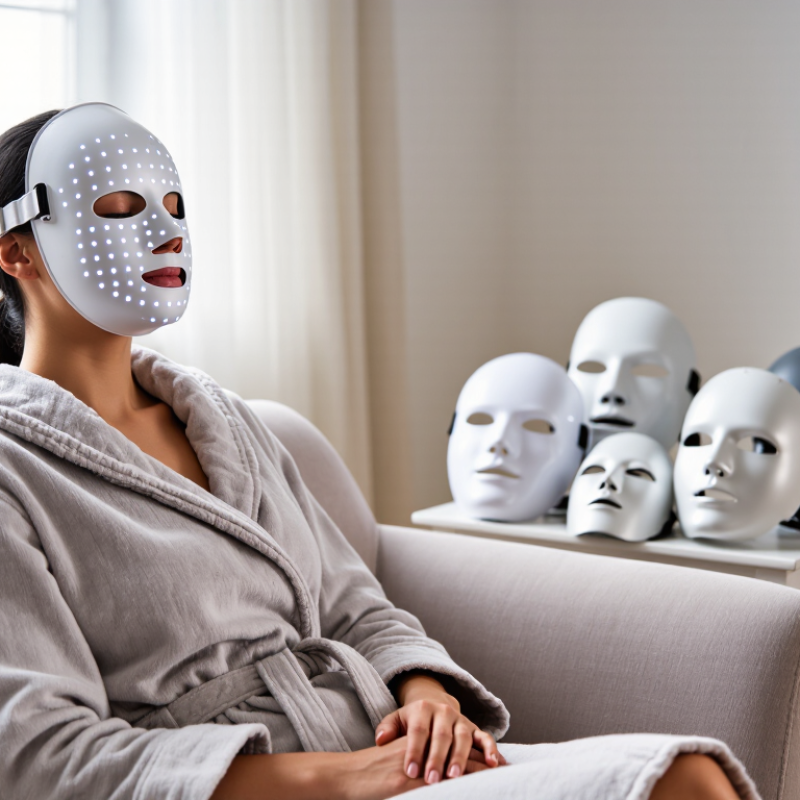
A good fit should illuminate the cheeks, forehead, nose, and jaw without pressing hard against the skin. Check that the eye openings sit comfortably and that the mask stays in place when you recline. Small gaps matter. A mask that shifts can leave areas unevenly exposed, especially around the nose or chin.
The American Academy of Dermatology estimates that acne affects up to 50 million people in the United States each year. That figure covers many different skin types and concerns, so it does not predict how one person will respond to LED treatment.
Compare the illuminated area, session length, and recommended weekly schedule before choosing. A ten-minute session may sound easy, but only if it fits your evening routine and the device covers the areas you want to treat. Follow the device’s instructions; do not add minutes to “make up” for missed sessions. The AAD’s acne guidance notes that evidence for light-based devices remains limited, so schedules should not be treated as interchangeable or guaranteed. Keep a simple log of session dates, comfort, and skin changes. It may feel a little tedious. That record can help you notice irritation or decide whether the routine is realistic.