2026 Best Position Sensor Types for Accurate Measurements?
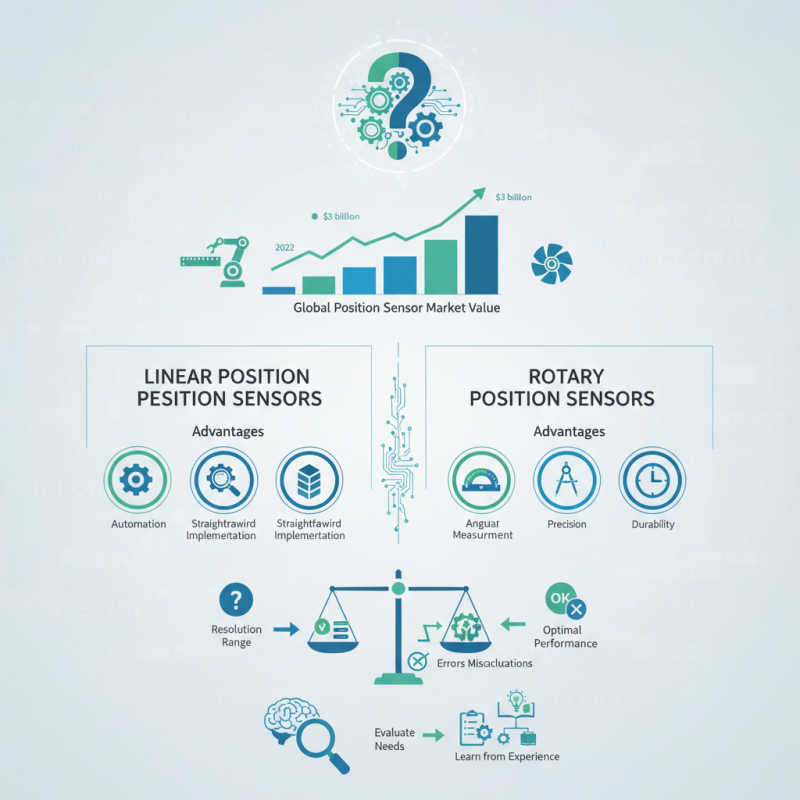
Position Sensors play a crucial role in numerous industries, from automotive to aerospace. They provide precise measurements, which are vital for system performance. According to industry reports, the global position sensor market was valued at over $3 billion in 2022 and is projected to grow significantly by 2026. This growth underscores the importance of selecting the right position sensor type for specific applications.
Different types of position sensors, including linear and rotary variants, each have unique advantages. For instance, linear position sensors are often favored for their straightforward implementation in automation tasks. Conversely, rotary sensors excel in applications involving angular measurement. However, not all sensors are created equal. Factors like resolution, range, and durability can impact their effectiveness. Discrepancies in sensor performance can lead to errors, affecting overall system accuracy.
As industries evolve, the demand for improved measurement capabilities increases. Choosing the correct position sensor type becomes more complex. This process may sometimes lead to miscalculations or oversights. Companies must critically evaluate their needs and the specifications of different sensor types. Ensuring optimal performance calls for careful analysis and a willingness to learn from past experiences.
Types of Position Sensors: An Overview
Position sensors are crucial for accurate measurements across various applications. They play a significant role in robotics, industrial automation, and aerospace. According to a recent industry report, the global position sensor market is expected to surpass $3 billion by 2026. This growth underscores the increasing demand for precision in measurement.
There are several types of position sensors. Potentiometric sensors are popular for their simplicity and cost-effectiveness. However, they can wear out quickly, leading to inaccuracies. Another type, inductive sensors, offer better durability and can measure with high precision, yet they may be affected by surrounding materials. Each type brings unique pros and cons.
Experts note that capacitive sensors are also gaining traction. They can provide high accuracy and are less prone to mechanical wear. But, these sensors require careful calibration. Misalignment in installation could lead to errant readings. With advancements in technology, the importance of selecting the right sensor type cannot be overstated. Careful consideration is essential for optimal performance.
Key Features of Accurate Position Measurement Devices
When selecting position sensors for accurate measurements, understanding their key features is essential. These devices should provide high precision and quick response times. According to industry reports, a significant percentage of sensor errors stem from environmental factors. Temperature fluctuations, humidity, and electromagnetic interference can degrade performance. Thus, choosing sensors with robust packaging can mitigate these issues.
Tips: Look for sensors with temperature compensation features. This could enhance reliability in fluctuating conditions.
Another critical aspect is measurement range. The best sensors effectively cover a wide range without compromising accuracy. Invest in sensors that offer fine resolution, as they minimize errors in measurements. For instance, some state-of-the-art devices boast resolutions in micrometers. However, it's vital to ensure the system is designed to handle such precision. Otherwise, you risk introducing new variables that may lead to incorrect readings.
Furthermore, the ease of integration into existing systems is paramount. A user-friendly interface saves time in setup and maintenance. Some sensors, despite their high accuracy, can be challenging to implement. There is a constant need to evaluate compatibility with your setup.
Tips: Engage with the manufacturer for support during integration. A good partnership can ease the transition and enhance overall performance.
Comparative Analysis of Common Position Sensor Technologies
Position sensors play a crucial role in various industries, including automation and robotics. Different types of position sensors offer varied technologies, each with strengths and weaknesses. For instance, potentiometers are simple but can wear out quickly. They are often used in applications requiring low cost. Optical sensors provide high precision but can be affected by dust and dirt.
Magnetic encoders are gaining popularity due to their robustness and reliability. According to recent industry reports, over 30% of manufacturers prefer magnetic encoders for industrial applications. They are less prone to environmental challenges and offer decent accuracy. However, they can face issues in environments with strong magnetic fields.
Capacitive sensors are known for their high sensitivity but may struggle with material variations. In some cases, they can provide erroneous readings if the target materials differ. As per technical evaluations, the market for capacitive sensors is projected to grow by 12% annually. Users must evaluate their specific needs. The right sensor choice can significantly impact efficiency and precision.
Applications of Position Sensors Across Various Industries
Position sensors play a crucial role in many industries. From automotive to aerospace, their applications are vast and varied. In manufacturing, position sensors assist in automation. They ensure precision in robotic arms and machinery. According to a recent industry report, the global market for position sensors is expected to reach $3 billion by 2026. This growth reflects the increasing demand for accuracy in production processes.
In the automotive sector, position sensors monitor critical functions. They detect throttle and brake positions, enhancing safety and performance. A study showed that 75% of vehicles now use these sensors for improved efficiency. Meanwhile, the aerospace industry relies on them for flight control systems. They help pilots navigate accurately, ensuring safe landings and takeoffs. Yet, not every sensor performs perfectly. Issues like environmental interference or calibration errors can occur. This shows the need for ongoing innovation.
In robotics, sensors are indispensable. They help navigate complex environments. But reliance on technology can come with challenges. If sensors fail, robots can misinterpret their surroundings. This highlights the importance of regular maintenance. Data from industry experts indicates that proper calibration can reduce errors by up to 30%. It’s critical for industries to continually assess their systems. Developing more robust sensor technology is essential for future applications.
Future Trends in Position Sensor Development and Accuracy
Position sensors are crucial for accurate measurements in various applications. As technology advances, their development is evolving. The push for higher accuracy drives innovations in sensor design and materials. Emerging trends point toward sensors with enhanced sensitivity and reduced noise levels. These improvements could lead to significant gains in measurement precision.
Recent studies spotlight the integration of smart technology in position sensors. These sensors can adapt to changes in their environment. This adaptability allows for real-time corrections, which improves accuracy. However, not all sensors can keep pace with these rapid changes. Some may struggle to integrate new technologies effectively. There is a need for ongoing research to address these gaps.
Another emerging trend is miniaturization. Smaller sensors can lead to more compact designs. They can fit into tighter spaces without sacrificing performance. But, decreasing size can also pose challenges. Smaller sensors must maintain accuracy and reliability. This makes designing them a delicate balance. In the quest for perfection, flaws may persist, necessitating continuous evaluation and improvement.
2026 Best Position Sensor Types for Accurate Measurements