

7 Best Automatic Feeding Gluing Machines for 2026?

A glue line rarely fails in dramatic fashion. More often, sheets drift slightly, adhesive builds on a nozzle, or operators pause to correct uneven folds. Those small interruptions matter when choosing an Automatic Feeding Gluing Machine for 2026. A useful comparison looks beyond advertised speed to feeding consistency, changeover time, glue control, operator access, and the carton sizes a plant actually runs.

Automation is expanding, but machine selection still needs context. The International Federation of Robotics reported 541,302 industrial robots installed worldwide in 2023, with 4.28 million operating globally, in World Robotics 2024. Those figures cover industrial robots, not gluing machines; they show the wider automation trend, not a guaranteed return from any particular purchase. Lean manufacturing engineer Shigeo Shingo’s well-known warning is relevant: “The most dangerous kind of waste is the waste we do not recognize.” In a gluing department, hidden waste may be setup delays or rejected cartons, not just labor hours.

There is no universal best machine. A compact line may suit short runs, while a high-volume plant may prioritize continuous feeding and rapid adjustment. The differences can be easy to miss in a showroom. This guide compares seven options using practical criteria: feeding accuracy, application control, format flexibility, maintenance access, and support. Treat specifications as starting points, then verify them against real samples and production conditions. A faster machine is not always a better one.
7 Best Automatic Feeding Gluing Machines for 2026?

What Automatic Feeding Gluing Machines Are and How They Work

Automatic feeding gluing machines move flat workpieces through a controlled gluing process with less manual handling. Depending on the machine, a belt, suction feeder, or friction rollers separate sheets from a stack. Sensors help detect each piece and keep it aligned as it enters the glue section. Applicator rollers or nozzles place adhesive along selected edges or surfaces. The machine then guides, folds, or presses the material so the glued areas meet.

The exact sequence depends on the product and machine setup. For a carton blank, guides may fold scored panels while pressure belts hold them in place as the bond begins to set. Operators typically adjust feed speed, glue volume, and alignment for the material being used. Too much adhesive can squeeze out; too little may leave a weak seam. Dust, curled sheets, or uneven stacks can also interrupt feeding. Not every jam has an obvious cause, so inspection matters.

Tips: Start with a small, even stack and check that its edges sit square against the guides. Test a few pieces before running a full batch. Look for continuous glue lines and clean folds, not just speed. Record settings that work, but recheck them when material thickness changes.

Key Components and the Automatic Feeding-to-Gluing Process

7 Best Automatic Feeding Gluing Machines for 2026?

Key Components and the Automatic Feeding-to-Gluing Process

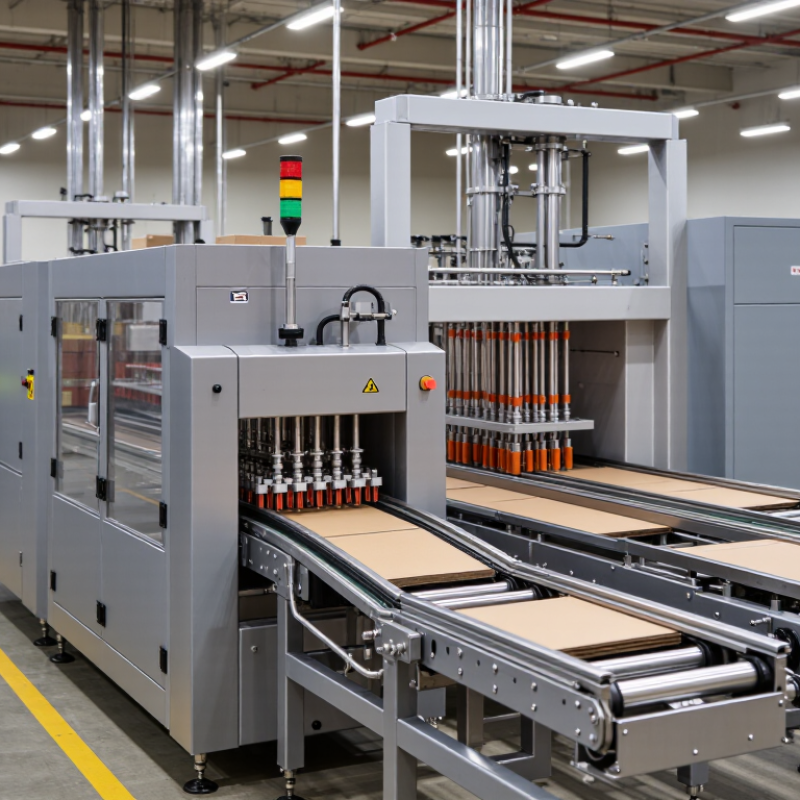
An automatic feeding-to-gluing line depends on coordinated parts, not just a fast applicator. A hopper stages flat blanks; a vacuum belt or friction feeder separates them one at a time. Photoelectric sensors detect gaps, while side guides and an encoder help keep each blank registered. The PLC links feed timing to glue-head activation. Small misalignments matter.

FEFCO’s 2023 European Database reports roughly 55 billion square metres of corrugated board production in Europe. That scale helps explain why stable feeding and repeatable bonding matter in carton plants. After separation, blanks travel through registration guides to the glue station. Nozzles apply a controlled bead; the machine then folds the panels and holds them under compression while the adhesive sets. Operators should check bead position, glue temperature, pressure, and dwell time against the adhesive and board specifications.

Sensors can flag a missed blank or interrupted feed, but they cannot judge every weak bond. Test samples from different shifts, and inspect edges for gaps, squeeze-out, or board damage. FEFCO’s production data describes a high-volume sector, yet a single warped blank can still disrupt a line. That part deserves more attention. Automation reduces repetitive handling; it does not remove the need for careful setup and regular cleaning.

Types of Automatic Feeding Gluing Machines for Different Applications

Automatic feeding gluing machines vary by material, glue pattern, and production flow. For folding cartons, a folder-gluer accepts printed blanks, folds scored panels, and applies adhesive along seams. Adjustable guides help keep narrow glue lines off visible surfaces. This type suits packaging shops handling repeatable box formats, though frequent size changes can require careful setup.

For corrugated cases, a sheet-fed gluing machine handles larger, stiffer blanks. Some models apply cold glue to flaps; others use hot-melt systems where a fast bond is useful. Bookbinding lines use different configurations, feeding covers or signatures into stations that apply adhesive along spines. Label and envelope applications often need precise, controlled glue deposits on smaller areas. Small details matter. Paper dust, curled stock, or uneven feeding can shift the glue line, even on an automated machine.

The right machine depends on the product’s shape and the required bond, not just its advertised speed. Check whether feeders accommodate your stock thickness and whether operators can adjust pressure, guides, and adhesive volume without long changeovers. A practical trial with real materials can reveal misfeeds or messy edges that specifications may not show. I would not assume one setup handles every job equally well; that is an easy mistake to make. Start with the most common product, then test the occasional formats.

7 Best Automatic Feeding Gluing Machines for 2026? – Types of Automatic Feeding Gluing Machines for Different Applications

Application-based guide to common machine types. Actual speed, feed range, and adhesive compatibility depend on the machine configuration and materials being processed.

Machine type Automatic feeding method Typical applications Common adhesive options Key selection points
1. Sheet-fed carton gluing machine Feeds flat paperboard blanks from a pile using a feeder and conveyor. Straight-line cartons, simple folding cartons, and paperboard packaging. Water-based cold glue; some setups can apply hot-melt adhesive. Check blank size, board weight, fold configuration, and glue-line accuracy.
2. Automatic folder-gluer Automatically feeds, aligns, folds, and glues carton blanks through connected sections. Folding cartons, crash-lock-bottom boxes, and multi-panel packaging. Usually water-based cold glue; hot melt may be used for selected designs. Match the machine to carton style, blank dimensions, changeover needs, and inspection requirements.
3. Corrugated case gluing machine Feeds corrugated blanks or case components through synchronized belts and guides. Shipping cases, corrugated cartons, and regular-slotted containers. Water-based adhesives, including suitable starch- or PVA-based formulations; hot melt may be used for some joints. Consider board thickness, flute profile, joint design, compression time, and required case dimensions.
4. Automatic bookbinding gluing machine Feeds book blocks or covers into a binding line for adhesive application and finishing. Paperback books, catalogs, manuals, and notepads. EVA or PUR hot melt for many perfect-binding processes; other adhesives may suit specific binding methods. Evaluate spine preparation, book thickness range, adhesive setting behavior, and binding strength requirements.
5. Automatic wet-glue labeling machine Feeds containers on a conveyor and transfers labels through a glue roller or labeling station. Paper labeling on glass, metal, or other suitable containers, including bottles and jars. Water-based wet-label adhesives selected for the label and container materials. Check container shape, label dimensions, surface condition, line speed, and wash-off or moisture needs.
6. Automatic roller adhesive applicator for boards and panels Feeds sheets or panels between rollers that spread adhesive over a surface or selected area. Lamination, panel assembly, furniture components, and other flat-material bonding operations. Water-based, solvent-based, or other roller-coatable adhesives, subject to material and equipment compatibility. Confirm coating width, wet-film control, panel thickness, cleanup method, and ventilation requirements where applicable.
7. Automatic conveyor-fed precision dispensing system Indexes or conveys parts under a programmed dispensing head; feeders can be integrated for repeatable part presentation. Electronics, appliance components, automotive parts, and assemblies requiring precise beads, dots, or patterns. Meterable materials such as silicone, epoxy, polyurethane, or hot melt, depending on the dispensing system. Assess material viscosity, shot size, path accuracy, curing process, and integration with part feeding and inspection.

Seven Notable Automatic Feeding Gluing Machines to Compare in 2026

Automatic feeding gluing machines differ in more than speed. In 2026, compare seven useful configurations: bottom-feed folder-gluers for cartons, top-feed systems for varied blanks, corrugated-board gluers, multi-point applicators, compact machines for short runs, servo-driven lines for frequent adjustments, and systems with inline inspection. These are practical categories, not a universal ranking. A machine that handles thin carton stock smoothly may struggle with warped corrugated sheets.

Check the details that affect daily work. Ask for sample runs using your own board, adhesive, and box design. Measure feeding accuracy, glue placement, changeover time, and reject rates—not just the advertised maximum speed. Watch how operators clear misfeeds and clean applicator nozzles. Small details matter. A quick changeover can lose its value if alignment takes repeated manual correction.

Compare safety features, spare-part availability, and service response alongside output. Confirm that the feeder supports your sheet dimensions and that the adhesive system suits your production conditions. Request written test results where possible, then verify them during a production trial. Paper specifications can look reassuring. Real stock may behave differently, and even experienced buyers can overlook that. Choose based on the work you actually run, including seasonal volume changes and the skills of your operators.

The scores are editorial priorities on a 1–5 scale, not measured ratings of specific machines. Compare each machine’s published specifications and confirm compatibility with your materials and production requirements.

How to Evaluate Performance, Compatibility, Safety, and Cost

7 Best Automatic Feeding Gluing Machines for 2026?

A useful comparison starts with repeatable performance, not a headline speed. Check how consistently each machine feeds your actual cartons, board, or other materials across a full production shift. Ask for sample runs using your own stock. Watch for skewed sheets, glue skips, and jams, especially near the end of a stack. Fast numbers impress. Stable output matters more.

Compatibility can make or break a purchase. Confirm the machine handles your material thickness, sheet sizes, adhesive type, and planned production volume. Review changeover time, too. If operators need tools and lengthy adjustments for every new format, small jobs may become surprisingly expensive. Record the settings and test them again after a changeover. Results can vary.

Safety and total cost deserve equal attention. Look for accessible emergency stops, guarded moving parts, clear operating instructions, and straightforward cleaning procedures. Ask how routine maintenance affects uptime, and price replacement parts, training, energy use, and adhesive waste alongside the purchase cost. A low initial price may not stay low. No estimate is perfect; leave room for downtime and the occasional messy setup.